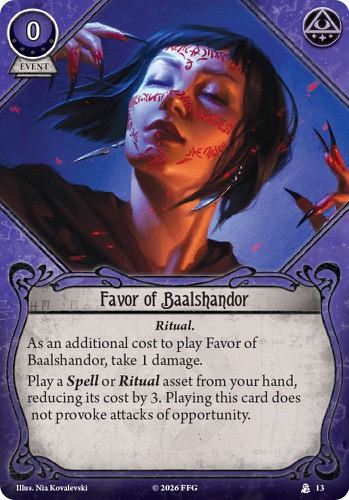
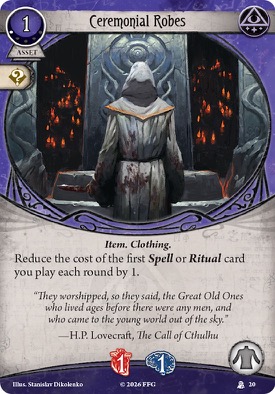
Alice Luxley is a member of the big family of "0xp allies that cost 4 resources, boost one stat and have an extra ability".
Her biggest liability is that she boost a weak stat for her class : most have only 2 , some 3, so it limits greatly the pool of investigators who can consider running her :
- In guardian : Wilson (who has bonus with Tools), Roland ( access for extra bonus), Carolyn (only with 4 )
- But she is also accessible to other investigators with 3+ , notably :
Skids and Jenny in , Ashcan in , and in Joe, Rex and Daisy with // back (note that outside Joe, all these investigators have // front you may also use). - For neutral investigators, i would consider her less important (Charlie can't use her ability if he exhausts her, and Lola will usually not be in the class when she finds clues). [TODO : test with // front Lola]
What can Alice bring to those investigators ?
-
Give a flat bonus in 0xp deck. Rogues may have Dario, but he usually won't be online from the start. Wilson has no other alternative at 0xp. But every of the other investigators i listed (excepted Skids) have acces, and could prefer one the 0xp seeker ally that boost intellect (Milan, Jeremiah, Whitton).
-
A unique ability. Lets compare Alice with her rivals :
– Dr. Milan Christopher gives resources
– Jeremiah Kirby gives cards
– Whitton Greene gives searches
– Alice Luxley gives damages
And... a damage, it's strong. It kills a Whippoorwill in when a figter would have used 2 actions. It brings the odd damage to help killing a big ennemy. On a little ennemy that doesn't hit hard (like an Acolyte), you can take an opportunity attack to get rid of him (without taking in option the solutions existing to find clues without attacks of opportunity, because unlike Milan, Alice works not only on tests, but on every clue discovery. That's stronger).
In a two-player game, one can easily concieve Alice dealing 4 to 6 damage : thats the firepower of a basic weapon, without loosing tempo or risking a Retaliate on a missed attack. Alice power is almost invisible (she either damages a big ennemy, or kills an unimportant one) but really powerfull all things considered.
Do you complain of the weakness of a 3 like Skids or Jenny to deal damage ? Their missing damage will be given by Alice. A card like Daring Maneuver can cancel AOO, or you could evade with Hatchet Man and kill it with Alice.
But if you really want to make a monsterkilling Alice, take a look at the : Gray's Anatomy allows her to deal damage 4 by 4, putting her in the same category that the best weapons of the game. Example (Joe is perfect for this) :
With The Raven Quill, your Gray's Anatomy won't take slots, won't give AOO and give an extra +2
Then you find a clue (with Working a Hunch, Field Agent, Empirical Hypothesis (easy to proc, you just made a 1-difficulty test with a base skill of at least 7)...
Alice deals 4 damage, ignoring every keyword like Retaliate, Aloof...
Another test with gray Anatomy, with Raven Quill upgrade, you ready Alice... And another 4 damage
Be careful, this combo can go live as soon a scenario 2, and your figter may feel totally useless for the rest of the campaign, as you will be better than him without loosing much on you main activity : finding clues.
Joe can even put Trusted on his Field Agent for more uses, and then use Gray's Anatomy for a big Soothing Melody heal.
(Man, this campaign was wild. Joe blasted the secret scenario of Scarlet keys without an issue.)
Side note : use of Alice in Synergy decks in
I find the Synergy archetype extremly strong, and a good reward for an atypic deckbuilding.
For example, Cheat the System becames the best event to win money : , 1xp, 5 resources.
Lola has an easy access to synergies thank to her permanents, but can use it at most, because Double, Double + Call for Backup becames the solution to every problem of the game : clues, movement, damage, heal, and everything testless.
This combo cost 2 resources... But good news, there is exactly a card giving not only those resources, but also 2 extra classes for your rogues : Antiquary.
→ a that want to play on the Synergies has mostly to look for and cards. And Alice becomes an excellent pick, notably by transforming your 2 damage into 3, and therefore trivialising the majority of the ennemies in the game.
Yay, finally ! Skids and Jenny, you dirty childs of the family, now is your time to shine !